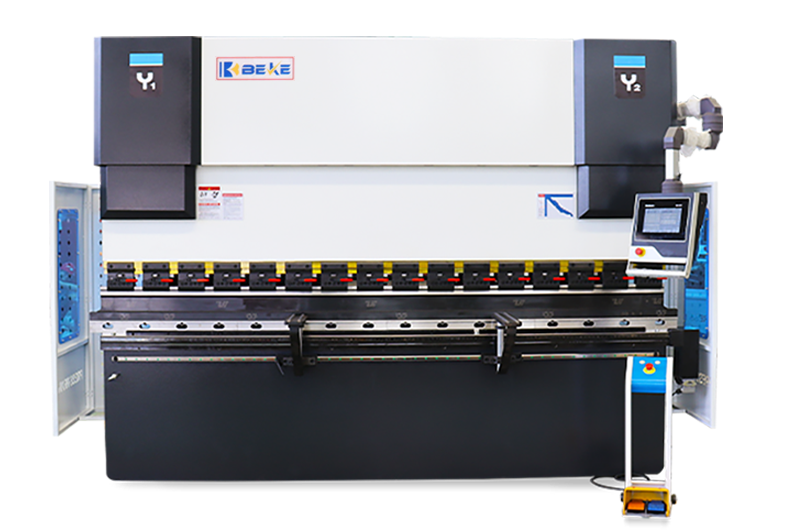
Introduce
Bending machine is a machine often used in metal processing workshops. Its function is to bend metal sheets into desired shapes and angles. For the press brake manufacture, the working principle of the bending machine is that the sharp tool upper die and lower die exert pressure on the metal sheet to make it bend.
There is an opening between the upper mold and the lower mold of the bending machine, and the metal sheet is placed in the opening, and then the upper mold and the lower mold respectively apply pressure to bend it. The upper mold is generally fixed, while the lower mold can be moved to adapt to different angles and pressure systems.
Working principle of bending machine
The principle is very simple, but it has a wide range of applications and can be used to produce metal parts of various shapes, such as boxes, casings, brackets, etc. The precision and efficiency of the bending machine depend on the quality of the machine, the design of the mold and the control of the pressure. Therefore, when using the nc press brake, it is necessary to pay attention to the operating procedures and safe operation to ensure the normal operation and production efficiency of the machine.
Various similar bending machines
Bending machines are the most commonly used bending machines in metal manufacturing. They use hydraulic or mechanical mechanisms to apply force to a sheet of metal, causing it to bend at a specific angle. There are many different types and sizes of press brakes to choose from, each with different bending capabilities and characteristics.
A. Hydraulic bending machine
Hydraulic press brakes use a hydraulic system to apply force to the sheet metal, which allows for greater control and precision than mechanical press brakes. They are also ideal for bending thicker or harder materials.
B. Mechanical bending machine
Mechanical press brakes use a mechanical system to apply force to the sheet metal with less precision than hydraulic press brakes. They are often used to bend thinner or softer materials.
C. CNC bending machine
CNC press brakes use computerized controls to automate the bending process, increasing precision and efficiency. They are ideal for high-volume production and complex bending projects.

Roll bender
Roll benders are used to bend sheet metal or sheets into cylindrical or conical shapes. They use three or four rollers to apply pressure to the metal so that it gradually bends around the rollers.
A. Three roll bending machine
A three-roll bender uses two bottom rolls and one top roll to form sheet metal or sheet metal. They are ideal for producing large diameter cylinders or cones.
B. Four Roller Bending Machine
Four-roll press brakes use two bottom rolls and two top rolls to form sheet metal or sheet metal, offering greater control and precision than three-roll press brakes. They are ideal for producing smaller diameter cylinders or cones.
What are the different types of bending machines, and what are their differences in function and features
There are several different types of press brakes used in metal fabrication, each with its own unique characteristics and capabilities. The following introduces the most common types of bending machines and their differences in functions and features:
- Bending machine: The most commonly used bending machine, a bending machine uses a hydraulic or mechanical mechanism to apply force to a sheet of metal to bend it at a specific angle. Bending machines come in many sizes and types, each with different bending capabilities and characteristics.
- Roll Bending Machines: Roll bending machines are used to bend sheet metal or plates into cylindrical or conical shapes. They use three or four rollers to apply pressure to the metal so that it gradually bends around the rollers. Roll benders are commonly used to produce pipes, tubing and other cylindrical objects.
- Folding machines: Folding machines work by sandwiching a sheet of metal between two or more clamps and bending it to the desired angle. They are commonly used to produce boxes, drawers and other sheet metal parts with straight sides.
- Rotary Stretch Bender: A rotary stretch bender uses a mandrel and a stationary die to bend metal tubing or pipe. The mandrel supports the inside of the tube during bending, preventing it from collapsing or deforming. Rotary stretch bending machines are commonly used in the production of plumbing fixtures, furniture and other tubular components.
- Incremental benders: Incremental benders use a series of small incremental bends to achieve complex shapes and angles. They are often used to produce complex sheet metal components such as aircraft components and automotive body panels.
Each type of nc press brake has its own unique features and capabilities, and the choice of machine depends on the specific needs of the application. Factors to consider when choosing a press brake include material type and thickness, desired bend angles, production volume, and budget.
What are some common maintenance tasks for press brakes
Bending machines are essential tools in metal fabrication, but like any other machine, they require regular maintenance to ensure optimum performance and longevity. Here are some common maintenance tasks for press brakes:
- Lubrication: Press brake components such as bearings, gears and sliders require regular lubrication to prevent wear and ensure smooth operation. The machine manual should provide instructions on which lubricant to use and how often.
- Inspection: Regular inspection of the press brake can help identify wear or potential problems before they cause serious problems. Inspections should include checking for loose or damaged parts, checking hydraulic systems for leaks, and checking electrical systems for damage or wear.
- Cleaning: The press brake should be cleaned regularly to prevent debris from accumulating, which can cause jamming or damage to machine parts. Cleaning involves wiping the machine with a soft cloth or brush, or using compressed air to blow away debris.
- Alignment: Misalignment of press brake components can result in inaccurate bends and damage to the machine. Regularly checking the machine’s alignment can help prevent these problems. The machine manual should provide instructions on how to check and adjust the alignment.
- Calibration: Regular calibration of a press brake’s gauges and measuring systems is critical to ensuring accurate bends and preventing material waste. The machine manual should provide instructions on how to calibrate the machine’s measurement system.
- Regular maintenance: Regular maintenance work, such as checking hydraulic oil levels, air filters, and hydraulic filters, helps keep machines in good working order. The machine manual should provide a maintenance schedule to follow.
By performing regular maintenance tasks, press brake manufacturer press brake owners can ensure that their machines run smoothly and reliably, reducing downtime and maintenance costs over the life of the machine. Be sure to follow the manufacturer’s maintenance instructions and consult a qualified technician should any problems arise.
Related Products